

The Blind Spot System delivers a comprehensive suite of safety features;
Utilising the new 77 GHz standard microwave radar, Blind Spot constantly monitors the blind areas along the sides of the vehicle. The system operates at all times and in all weather conditions, and delivers real-time visual and audible alerts to potential collisions with other vehicles, motorcycles, cyclists and pedestrians that may be hidden in the driver’s blind spots.
Advanced Radar
Based Blind Spot Detection


Visual and audio alerts notify drivers of real time potential dangers.
High-Speed Detection
Higher frequency bands allow for greater resolution and a wider field of view. Precise measurements regardless of target appearance, vehicle shape, or color.


Unwavering Performance
Unlike cameras, 77 GHz radar waves penetrate rain, snow, fog, and direct sunlight with remarkable consistency. Effectiveness is never compromised when visibility is low.
Non Line-of-sight
Radar can potentially "see" through certain materials and foliage, offering comprehensive awareness beyond simple visual line-of-sight. Unlike cameras, radar is unaffected by road grime, ice and foreign material.

Truck blind spots are larger, longer, and more dangerous than passenger vehicles. Mirrors and cameras alone cannot provide complete situational awareness.
A modern BSIS delivers:
-
Continuous monitoring of critical blind zones
-
Real-time detection of vehicles, cyclists, and pedestrians
-
Immediate driver alerts (visual + audible)
-
Collision risk prediction and intervention support
These systems are specifically designed to reduce side-impact incidents, protect vulnerable road users, and improve driver confidence in high-risk environments.
The Power of 77 GHz Radar Technology
Precision Detection – Beyond Line of Sight
77 GHz radar uses high-frequency radio waves to detect objects independent of visibility conditions or lighting.
-
Measures distance, speed, and trajectory simultaneously
-
Detects both moving and stationary objects
-
Tracks multiple targets in real time
-
Provides predictive collision warnings
Unlike visual systems, radar does not rely on interpreting images—it delivers direct, physics-based measurement of the environment.
All-Weather, All-Conditions Reliability
One of the most critical advantages of radar:
-
Operates effectively in rain, fog, dust, darkness, and glare
-
Unaffected by sunlight or shadows
-
Maintains performance even when sensors are partially obscured
Camera-based systems degrade significantly in poor conditions, while radar continues to perform precisely when risk is highest.
True 360° Awareness for Commercial Vehicles
Radar systems can be configured to cover:
-
Nearside blind spots (critical for cyclist safety)
-
Offside lane-change zones
-
Front “moving-off” danger zones
-
Rear and trailer articulation areas
Advanced systems can even:
-
Detect through partial obstructions (e.g. foliage, structural elements)
-
Monitor long vehicle combinations (prime mover + trailer)
-
Reduce false alerts through intelligent object classification
Built for Commercial Fleet Demands
77 GHz radar systems are engineered for:
-
Heavy-duty environments (construction, waste, logistics)
-
CAN integration with modern fleet vehicles
-
Long operational life with minimal maintenance
-
High reliability under vibration, dirt, and continuous use
This makes them ideal for fleet-wide deployment at scale.
Camera-Based Systems
Camera systems rely on visual input and image processing algorithms.
Advantages:
-
Provide visual confirmation to the driver
-
Useful for recording and incident review
-
Lower upfront cost in some configurations
Limitations:
-
Performance drops in low light, glare, rain, or fog
-
Requires clean lenses and ongoing maintenance
-
Detection depends on software interpretation of images
-
Limited to line-of-sight visibility
-
Higher likelihood of missed detections or false alerts
77 GHz Radar-Based Systems
Radar systems use electromagnetic sensing to detect objects directly.
Key Advantages:
✔ All-weather operation – unaffected by environmental conditions
✔ Accurate speed & distance measurement – critical for collision prediction
✔ Penetrates visual obstructions – enhanced detection coverage
✔ Low maintenance – no lenses or image clarity issues
✔ Consistent performance day and night
✔ Reduced false alarms through precise object tracking
Radar delivers consistent, repeatable performance regardless of visibility, making it the superior safety layer for blind spot monitoring.
Safety Benefits for Drivers
-
Reduced cognitive load – no need to constantly check mirrors and screens
-
Earlier hazard detection in high-risk urban environments
-
Clear, immediate alerts when it matters most
-
Increased confidence during lane changes and turns
Ultimately, radar systems act as a continuous co-driver, monitoring areas the driver physically cannot.
Safety & Commercial Benefits for Fleet Operators
Risk Reduction & Compliance
-
Supports compliance with ADR 105/00 requirements
-
Reduces incident rates involving cyclists and pedestrians
-
Minimises insurance exposure and liability
Operational Efficiency
-
Fewer vehicle downtime events from accidents
-
Lower repair and insurance costs
-
Improved driver retention and satisfaction
Brand & Reputation Protection
Demonstrates a proactive commitment to:
-
Road safety
-
Community protection
-
Corporate responsibility
For operators serious about safety, compliance, and operational performance, radar-based BSIS is not optional—it is essential.
Talk to us today about implementing 77 GHz radar-based Blind Spot Information Systems across your vehicles.
Shifting Gears:
Radar vs Cameras
In the ever-evolving landscape of automotive safety, radar-based blind-spot detection systems stand out as cutting-edge technologies that significantly enhance driver safety. These systems serve as vigilant electronic guardians, mitigating the risks associated with one of the most perilous aspects of driving – the blind spot.
Radar-based blind-spot detection systems employ advanced radio frequency technology to detect vehicles and pedestrians in the adjacent lanes that may elude the driver's direct line of sight. These systems provide real-time information on the proximity and speed of vehicles including bicycles approaching from either side of the vehicle, offering a crucial layer of awareness that aids in safe lane changes. The radar's ability to operate in various weather conditions, such as rain or fog, ensures reliability even when visibility is compromised.
While both radar and camera-based systems can be used for blind spot monitoring, 77 GHz radar technology offers significant advantages, establishing it as a superior approach for reliable and robust blind spot monitoring.
The primary benefit of 77 GHz radar lies in its unwavering performance across diverse environmental conditions. Unlike cameras, which can be easily hampered by rain, snow, fog, direct sunlight, or darkness, radar waves penetrate these elements with remarkable consistency. This ensures the BSIS remains effective when visibility is compromised – precisely when a driver might need it most. Cameras, on the other hand, are susceptible to lens obstruction from dirt or precipitation, and their image processing capabilities can degrade in low light or glare, leading to unreliable detection or false alarms.
Furthermore, 77 GHz radar excels in accurately detecting the speed and distance of other vehicles. Its higher frequency band allows for greater resolution and a wider field of view compared to older, lower-frequency radar systems, and crucially, it provides precise measurements regardless of the target vehicle's appearance or lighting. Camera systems rely on complex algorithms to interpret visual information, which can sometimes struggle with varying vehicle shapes, colours, or poor contrast.
Another key distinction is the radar's ability to "see" through certain materials. This means it can potentially detect a vehicle obscured by dense foliage or even, to some extent, the B-pillar of the car itself, offering a more comprehensive awareness of the surrounding environment. Camera systems are limited to line-of-sight, meaning anything visually obstructed remains undetected.
In essence, while cameras contribute valuable visual information for other advanced driver-assistance systems (ADAS), the inherent robustness, all-weather capability, and precise detection offered by 77 GHz radar make it the more dependable and therefore superior technology for the critical safety function of blind spot information systems. This technological edge translates directly into enhanced driver confidence and a safer driving experience.
77 GHz Radar: Superior All-Weather Guardian for Blind Spots

The benefits of 77 GHz radar over 24 GHz radar are significant. Firstly, the higher frequency allows for a more precise range resolution, enabling better object detection and tracking in complex environments. Secondly, the shorter wavelength enhances radar imaging capabilities, enabling finer details and improved accuracy in target identification. Additionally, 77 GHz radar offers improved angular resolution, enabling better discrimination between closely spaced objects. Moreover, it provides better performance in adverse weather conditions like fog or rain, ensuring reliable operation. Lastly, the higher frequency band offers increased bandwidth, allowing for higher data transmission rates, facilitating faster and more efficient radar systems which results in systems that are much more accurate in detecting smaller objects such as pedestrians and bicycles and also have a much reduced occurrence of false or missed alerts.
Capabilities
Blind Spot Detection (BSD)

The Blind Spot Sentinel system utilises a 77 GHz short-range radar sensor mounted on the sides of the vehicle's cabin to constantly monitor the driver’s blind spot zones. The radar continuously detects a wide variety of stationary and moving objects in the driver’s blind spot, while the algorithm filters out the stationary objects. This allows the system to warn the driver only of moving objects (objects travelling in the same direction) and only in the adjoining lanes.
Lane Change Assistance (LCA)
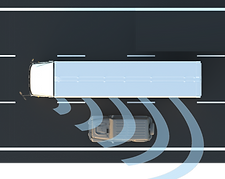
If the driver indicates a lane change to a lane that contains a moving object in the blind spot, turning on the indicators will create a Level 2 warning buzzer along with appropriate visuals on the LED display lighting up to alert the driver to the current situation.
Corner Navigation Assistance (CNA)

If the vehicle’s indicator is lit and the vehicle starts to turn, the inside position closest to the curb will be surveyed by the radar sensor. In this mode the radar signature will detect any moving pedestrians, motorcycles and bicycles and the driver of the vehicle will be alerted by the buzzer and LED display.
SUITABLE FOR ANY 12 - 36 VOLT VEHICLE
SEES WHAT DRIVERS CAN'T
Our advanced Blind Spot System (BSS) utilizes radar technology to detect vehicles in the driver’s blind spots. When it detects a vehicle, it provides visual and audible alerts to warn the driver of potential collisions. The system also helps drivers merge safely into adjacent lanes by checking them for clearance. The BSS is an Advanced Driver Assistance System (ADAS) that helps prevent or mitigate truck crashes caused by side collisions. It is an essential component to ensure the safety of drivers and other passengers on the road.
TECHNOLOGY MADE FOR TRUCKS
The BSS is a robust and waterproof technology specifically developed to address the risk of incidents due to poor visibility and blind spots around trucks. Designed for quick and easy installation on any type of truck or van. It is built to ensure reliable performance in all weather conditions and is suitable for vans, rigid trucks and semi-trailers. It is covered by a 2 year warranty against any manufacturing defects.
CYCLIST AND PEDESTRIAN AWARE
BSS is a revolutionary technology that helps drivers stay safe on the road. It uses advanced radar detection to identify pedestrians and cyclists in the driver's blind spots, providing an extra layer of safety for both drivers and those around them. With BSS, drivers can rest assured that they are driving with the highest level of safety, and can quickly and reliably detect any possible obstacles. BSS is a must-have technology for any driver looking to stay safe on the roads.